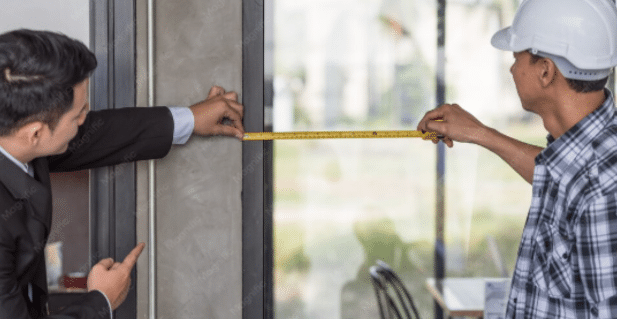
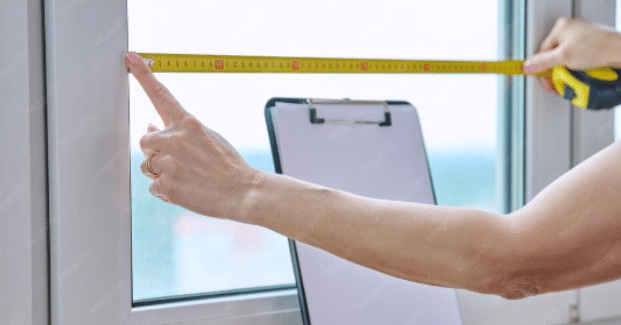
Every blind installation starts with measurements. Skip this step or rush through it, and nothing else matters. The brackets will not line up, the headrail will be too wide, or you will end up with a gap on one side that lets light pour through. We measure nine points per window on every job, and roughly one out of every five customers who calls us already tried ordering online with their own measurements and got it wrong.
Before you measure anything, gather a steel tape measure (cloth tapes stretch and give inaccurate readings), a pencil, a notepad, and a step stool. You will also want a level. Write down every measurement as you go. Do not round up. Do not round down. Record to the nearest 1/8 inch.
For inside mount, you are measuring the space inside the window frame. Measure the width at three points: top, middle, and bottom of the opening. Use the narrowest of the three. Then measure the height at three points: left, center, and right. Use the longest measurement. Finally, measure the depth of the frame from front edge to the glass. That depth determines whether your chosen product fits inside the frame at all.
Most roller shades need at least 1.5 inches of depth. Faux wood blinds need 2.5 inches. If you are short by even a quarter inch, inside mount is off the table. Our inside vs outside mount guide covers the full breakdown.
For outside mount, measure the area you want the blinds to cover rather than the frame opening. Add 2 to 4 inches on each side for proper overlap and light blocking. Measure from where the top of the headrail will sit down to where you want the bottom of the blind to fall. Outside mount is more forgiving on width, but height still needs to be precise.
The biggest mistake we see? Measuring only once at a single point. Windows are rarely perfectly square, especially in older Miami homes. The second most common mistake is ignoring frame depth for inside mounts. You can have the width and height dialed in perfectly, but if the frame is too shallow, the blinds stick out past the trim and look unfinished.
Want to skip the risk entirely? We offer a free professional measurement across Miami-Dade, Broward, and Monroe County. Call 786-207-1617 and one of our team comes out with precision tools and measures every window in the house.
Here is the honest version. Some blind types are straightforward to hang yourself. Others get complicated fast, and a mistake with the drill means holes in your wall or frame that you cannot undo.
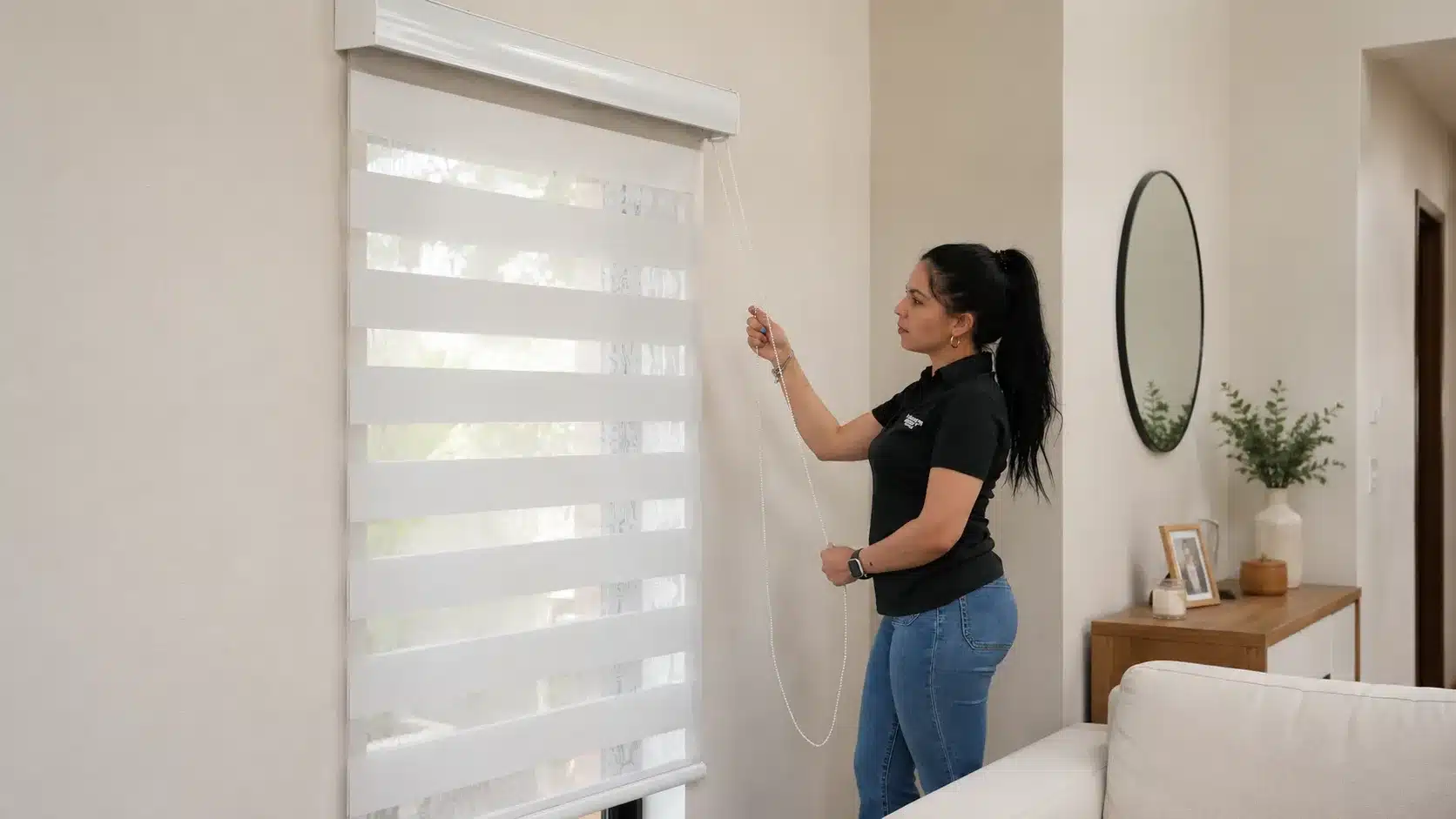
Roller shades use a similar bracket system. Two end brackets hold the tube, and the shade rolls up and down on that tube. Installation is clean if the window is square and the brackets are level. If you ordered the shade for inside mount, the fit needs to be precise. Too tight and the shade rubs the frame when it rolls. Too loose and you get light gaps.
Vertical blinds for sliding glass doors are a step up in complexity. The track is longer, heavier, and needs to be perfectly level across the full span. Carrier clips inside the track hold each vertical panel, and they need to be evenly spaced for the panels to hang straight. On a standard 6-foot sliding door, this is manageable. On a 10 or 12-foot opening, the track can sag in the middle without proper support brackets.
Not every window treatment is a weekend project. Some products, window types, and building situations make professional installation the practical choice rather than the premium one.
Motorized shades involve wiring (hardwired systems), battery packs, or integration with smart home hubs. The motor housing adds weight and size to the headrail, which changes the bracket requirements. Hardwired systems need electrical work behind the wall or inside the frame. Even battery-powered motorized shades require precise mounting so the motor does not strain against a misaligned bracket. If you are considering motorized options, our motorized smart blinds guide covers what to expect.
Arched windows, angled windows, bay windows, and floor-to-ceiling spans all require custom mounting solutions. A 120-inch-wide window needs a reinforced headrail with center support brackets that standard hardware kits do not include. Arched and angled windows need templates cut to the exact shape. These are not situations where a YouTube video gets you through.
Shutters always need professional installation. The frame is built to fit inside the window opening at tight tolerances, and the hinge system needs to be aligned so the panels swing freely without rubbing the frame or each other. A shutter frame that is off by 1/16 of an inch will bind when you try to open or close it.
Hotels, office buildings, and retail spaces involve fire code compliance, ADA clearances, and building management coordination. The hardware requirements are different from residential, and the volume means any mistake multiplies across dozens or hundreds of windows.
[IMAGE: A professional installer mounting bracket hardware on a large floor-to-ceiling window in a modern Miami condo. Tools visible, clean work area, natural light from adjacent windows. Professional attire, shot from mid-distance.
Most online installation guides assume drywall over wood studs in a single-family home. That is not what most of South Florida looks like.
Many Miami condo associations restrict what you can install on windows visible from the exterior. Some require white or off-white backing on all window treatments. Others prohibit any modification to the window frames. Before you buy anything, check your association rules. We deal with HOA and condo board requirements every week and can tell you upfront whether your product choice will pass.
Impact-resistant windows are standard in South Florida construction post-2002. The frames are thicker, the glass is laminated, and drilling into the frame can compromise the impact rating. You cannot just sink screws into an impact window frame the way you would a standard aluminum frame. We use specialized mounting techniques that secure the blinds without affecting the window’s hurricane certification.
Condos and newer construction in Miami use concrete block walls, not wood-framed drywall. Standard drywall anchors will not hold in concrete. You need a hammer drill, masonry bits, and concrete-rated anchors. The dust is substantial, the noise carries through the building, and hitting a rebar inside the wall means repositioning the bracket. If you have never drilled into concrete, this is the step where most DIY installations stall.
Properties near the coast deal with salt air corrosion. Standard steel brackets and screws will rust within a year or two in Brickell, Key Biscayne, or anywhere within a few miles of the water. We use stainless steel and corrosion-resistant hardware on coastal installations. It costs slightly more upfront and saves a callback two years later.
Miami condos present unique challenges that most online guides do not cover. Chris, who has been measuring and installing window treatments across Miami-Dade for over 15 years, puts it this way: “Half the calls we get from condo owners start with ‘I tried to install these myself.’ The concrete walls, the impact windows, the HOA rules on exterior appearance. You have three variables that do not exist in most parts of the country, and they all show up in the same building.”
Robert adds: “We have done whole floors of condo towers where every unit has a slightly different frame depth because of how the building settled. You cannot just order one size for all 12 units on a floor. Each window gets its own measurements.”
That is the difference between a local manufacturer who works in South Florida every day and a set of instructions packed in a box from a warehouse in another state. Miami’s Best Blinds has handled thousands of these installations, and the pattern is consistent: the buildings here demand a different approach than the rest of the country.
A single window takes 15 to 30 minutes depending on the product type and mounting surface. A whole-home project with 10 to 15 windows typically takes one full day. Motorized installations take longer because of wiring and programming. We schedule a specific time block based on your window count so you know what to expect.
Yes, but not the same way you would on standard windows. Impact window frames are engineered to specific tolerances, and drilling into them incorrectly can compromise the seal or the impact rating. We use mounting methods that secure the brackets without affecting the window certification. This is one situation where professional installation is not optional.
You need a hammer drill with masonry bits and concrete-rated anchors. A standard cordless drill with wood screws will not work. If you own a hammer drill and have drilled into concrete before, it is doable. If this would be your first time, the learning curve is steep and the margin for error is small.
Yes. Every custom order from our Cutler Bay manufacturing facility includes professional measurement and installation. Our team measures your windows, builds the product to your exact specifications, and installs everything. The measurement and installation are part of the service.
Whether you are leaning toward doing it yourself or want the whole job handled, the right starting point is the same: accurate measurements. Our team comes to your home, measures every window at nine points, checks frame depth, identifies any mounting challenges specific to your building, and walks you through your options.
We fabricate every product in our Cutler Bay facility and install across Miami-Dade, Broward, and Monroe County. Call 786-207-1617 for a free consultation, or learn more about our professional measurement service. If you are ready to explore product options, see our full line of custom blinds in Miami or read about our drapery installation process.
[IMAGE: A completed whole-home blinds installation in a bright Miami residence showing multiple windows with coordinated window treatments. Wide-angle shot capturing the living area and adjacent rooms. Natural South Florida light, clean modern interior.