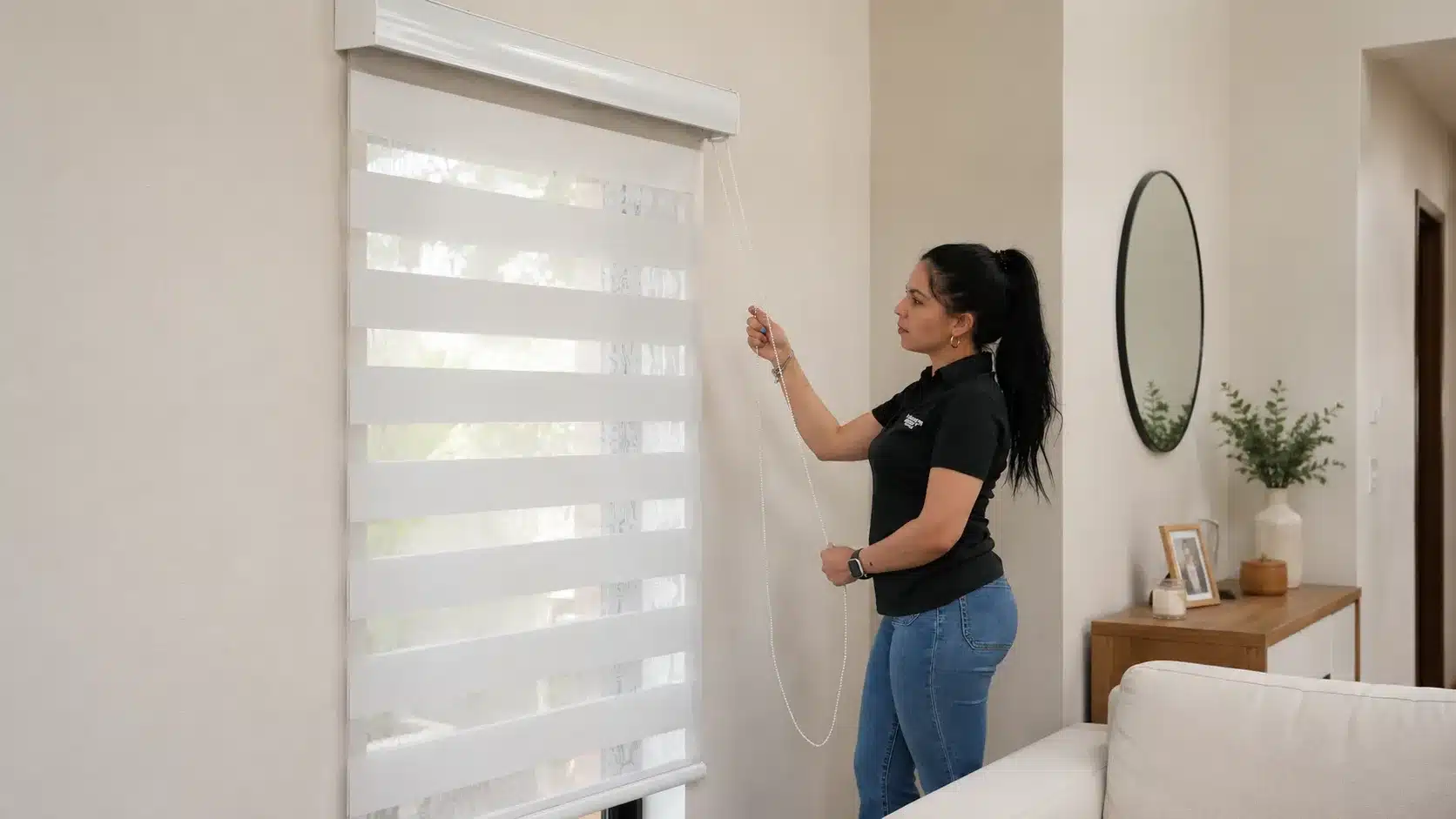
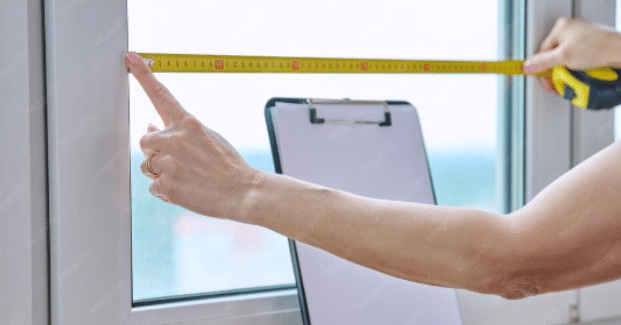
Inside mount blinds are installed within the window frame, giving your windows a clean and fitted appearance. However, this mounting style requires accurate measurements because the blind must fit within the available opening.
To measure windows for inside mount blinds, measure the inside width across the top, middle, and bottom of the frame. For most products, you will record the smallest width. Next, measure the height on the left, in the center, and on the right. Finally, measure the usable depth of the frame and check for handles, locks, or cranks that may block the blind.
Even a small measuring mistake can cause the blind to rub against the frame, leave uneven light gaps, or not fit at all. This step-by-step guide will help you measure your windows correctly and understand what to check before ordering custom blinds.
What You Need to Measure Your Window
You do not need special equipment to measure a window for inside mount blinds. A steel tape measure, a pencil, and something to record your measurements are usually enough. You may also need a stable step ladder if the top of the window is difficult to reach.
Always use a steel tape measure instead of a cloth measuring tape. A cloth tape can bend, stretch, or sag, which may result in an incorrect measurement. Since custom blinds are made using the dimensions you provide, even a small difference can affect the final fit.
Record every measurement to the nearest 1/8 inch. For example, if the width is 35 5/8 inches, write down that exact measurement instead of rounding it to 35 or 36 inches.
It is also a good idea to measure every dimension twice. If the two results do not match, measure again before recording the final number.
Before You Measure, Check That an Inside Mount Will Work
An inside mount means the brackets and headrail are installed within the window opening. This creates a neat appearance and allows the surrounding window trim to remain visible.
However, not every window is suitable for an inside mount. The frame must have enough clear space to hold the brackets, headrail, cassette, and any other parts of the selected blind.
Check the Window Depth
Window depth is the distance between the front edge of the window opening and the glass. This space must be deep enough for the blind’s mounting hardware.
Different types of blinds require different amounts of depth. A simple mini blind may fit inside a shallow frame, while a motorized zebra shade with a larger cassette may need considerably more space.
Measure the depth where the brackets will be installed, usually along the top of the frame. Take a measurement near the left side, in the center, and near the right side. Use the smallest usable depth when checking whether your chosen product will fit.
The product information should provide two important dimensions. The minimum mounting depth tells you how much space is needed to install the brackets. The minimum flush-mount depth tells you how much space is needed for the complete headrail or cassette to sit within the frame without projecting forward.
A blind may still work when the frame meets the minimum mounting depth but not the flush-mount depth. In this situation, part of the headrail may extend beyond the front of the window opening.
Check for Handles, Locks, and Cranks
Look carefully at the entire window opening before taking your final depth measurement. Window handles, locks, cranks, alarm sensors, screens, and raised tracks can reduce the usable space.
For example, a frame may appear to be three inches deep, but a handle may project one inch into the opening. In that case, the blind does not have the full three inches available.
The blind should be able to raise, lower, and tilt without touching the window hardware. If a handle or lock blocks the treatment, you may need a lower-profile blind, a partial inside mount, or an outside mount.
How to Measure Windows for Inside Mount Blinds
Once you have confirmed that an inside mount is possible, you can begin measuring the width, height, and depth of the opening.
Step 1 — Label Each Window
Give every window a clear name before recording its measurements. You might use labels such as “Living Room Left,” “Kitchen Window,” or “Primary Bedroom Right.”
This is especially important when ordering blinds for several rooms. Two windows may appear identical but still have slightly different dimensions. Small changes in framing, plaster, trim, or construction can affect the final size.
Never measure one window and use that size for all similar windows. Measure each opening separately.
Taking a photo of every window can also help. Save the photo with the same label used on your measurement sheet so you can match each set of measurements with the correct opening.
Step 2 — Measure the Inside Width
Place the steel tape measure inside the window opening. Measure from the inside edge of the left side of the frame to the inside edge of the right side.
Take three width measurements. Measure once across the top of the opening, once through the middle, and once across the bottom. Keep the tape straight and level each time.
Window openings are not always perfectly square, so the measurements may be slightly different. This is normal.
For example, your measurements might be:
Top width: 36 inches
Middle width: 35 7/8 inches
Bottom width: 35 3/4 inches
For most inside mount blinds, you should record the smallest width, which would be 35 3/4 inches in this example. Using the narrowest measurement helps the blind fit through the tightest part of the opening without rubbing against the frame.
Do not measure only the visible glass. The blind will be installed within the complete window opening, so measure from one inside edge of the frame to the other.
Although the smallest width is commonly used, some products may have different measuring rules. Always compare your measurements with the instructions for the exact blind or shade you plan to order.
Step 3 — Measure the Inside Height
Measure the height from the top inside edge of the window opening to the top of the sill. If the window does not have a projecting sill, measure to the bottom inside edge of the frame.
Take three height measurements. Measure along the left side, through the center, and along the right side. Keep the tape straight from top to bottom.
For example, the measurements may be:
Left height: 58 inches
Center height: 58 1/8 inches
Right height: 57 7/8 inches
Write down all three measurements.
The correct height to submit can vary by product. Many horizontal blinds, faux wood blinds, cellular shades, and Roman shades use the longest height. Some roller shades, vertical blinds, and other systems may use the shortest height to prevent the treatment from dragging or binding.
Because the rule is not the same for every product, record all three measurements and follow the instructions provided for the exact blinds you are ordering.
Step 4 — Measure the Window Depth
Measure from the front edge of the window opening toward the glass. Take the measurement near the top-left, top-center, and top-right of the frame because this is where the brackets or headrail will usually sit.
Use the smallest clear depth.
For example, your measurements may be:
Left depth: 2 1/2 inches
Center depth: 2 3/8 inches
Right depth: 2 1/2 inches
The usable depth would be 2 3/8 inches.
Compare this number with the minimum mounting depth and flush-mount depth listed for the selected blind. Remember to account for handles, locks, cranks, and other objects that project into the opening.
Depth determines whether the brackets can be installed, whether the blind can sit fully within the frame, and whether the treatment will move without touching the glass or window hardware.
Step 5 — Check Whether the Window Is Square
A window can have accurate width and height measurements but still be uneven. You can check this by measuring diagonally across the opening.
First, measure from the top-left corner to the bottom-right corner. Then measure from the top-right corner to the bottom-left corner.
If the two diagonal measurements are the same or very close, the window is likely square. If they are noticeably different, the opening may be uneven.
A slightly uneven frame does not always prevent an inside mount. However, it may create unequal side gaps, cause the bottom rail to appear crooked, or make the blind rub against one side of the frame.
If the opening is badly out of square, an outside mount may provide a cleaner and more balanced result.
Step 6 — Record Your Measurements Correctly
Blind measurements are normally written with the width first and the height second.
Use this format:
Width × Height
For example:
35 3/4 inches W × 58 1/8 inches H
Write the window label beside every set of measurements. This will help prevent confusion when ordering several custom blinds.
Keep the original top, middle, and bottom width measurements and the left, center, and right height measurements until your order is complete. You may need them if the product has special measuring instructions.
Should You Subtract From the Measurements?
Do not subtract anything from your measurements unless the blind manufacturer or installer specifically tells you to do so.
Many custom blind companies ask for the exact size of the window opening. They then make a small factory deduction from the finished product so the blind can fit and move smoothly within the frame.
If you subtract an additional amount yourself, the finished blind may be too narrow. This can create larger side gaps, reduce privacy, allow more light into the room, and make the installation look uneven.
There is no universal deduction that works for every type of blind. The correct adjustment may depend on the product, brackets, headrail, cassette, control system, and manufacturer.
Submit the exact opening measurements unless the supplier’s instructions clearly say otherwise.
Common Mistakes When Measuring for Inside Mount Blinds
One of the most common mistakes is measuring the visible glass instead of the complete inside opening. The blind is installed within the frame, so the glass measurement does not provide the correct ordering size.
Another common problem is measuring the width in only one place. Even modern windows can be slightly narrower at the top, middle, or bottom. Taking three measurements helps identify the tightest part of the opening.
Many homeowners also forget to measure the depth. A blind may have the correct width and height but still fail to fit because the brackets or cassette are too deep for the available recess.
Window hardware is another important consideration. Handles, locks, cranks, alarm sensors, and screens can interfere with the blind even when the frame appears deep enough.
Avoid rounding measurements to the nearest full inch. Custom blinds require precise dimensions, so record each number to the nearest 1/8 inch.
You should also avoid reversing the width and height when placing your order. Always write the width first, followed by the height.
Finally, measure every window individually and do not make your own deduction unless instructed. Measure each dimension twice before submitting the order.
What If the Window Measurements Are Different?

It is normal for the top, middle, and bottom width measurements to be slightly different. Window frames can shift, bow, or become uneven over time.
For most inside mount blinds, use the smallest width because the blind must fit through the narrowest part of the opening. Do not average the three measurements.
For example, suppose the top measures 40 inches, the middle measures 39 7/8 inches, and the bottom measures 39 5/8 inches. The width you would normally record is 39 5/8 inches.
Small differences are usually manageable. However, a large difference may cause the blind to sit unevenly or rub against the frame. An outside mount may be a better option when the opening is significantly uneven.
What If the Window Is Not Deep Enough?
A shallow frame does not always prevent you from choosing an inside mount.
Some blinds can be installed as a partial inside mount. The brackets sit within the opening, but part of the headrail, cassette, or valance projects beyond the front of the frame.
You may also be able to choose a lower-profile blind with a smaller headrail. A standard roller shade, cellular shade, or mini blind may require less space than a large cassette system.
If the available depth is still too small, an outside mount is usually the most practical choice. Outside mount blinds are installed on the wall or trim around the window and do not depend on the depth of the recess.
Do not remove important locks, impact-window parts, or structural components to create space for a blind.
Inside Mount vs Outside Mount Blinds
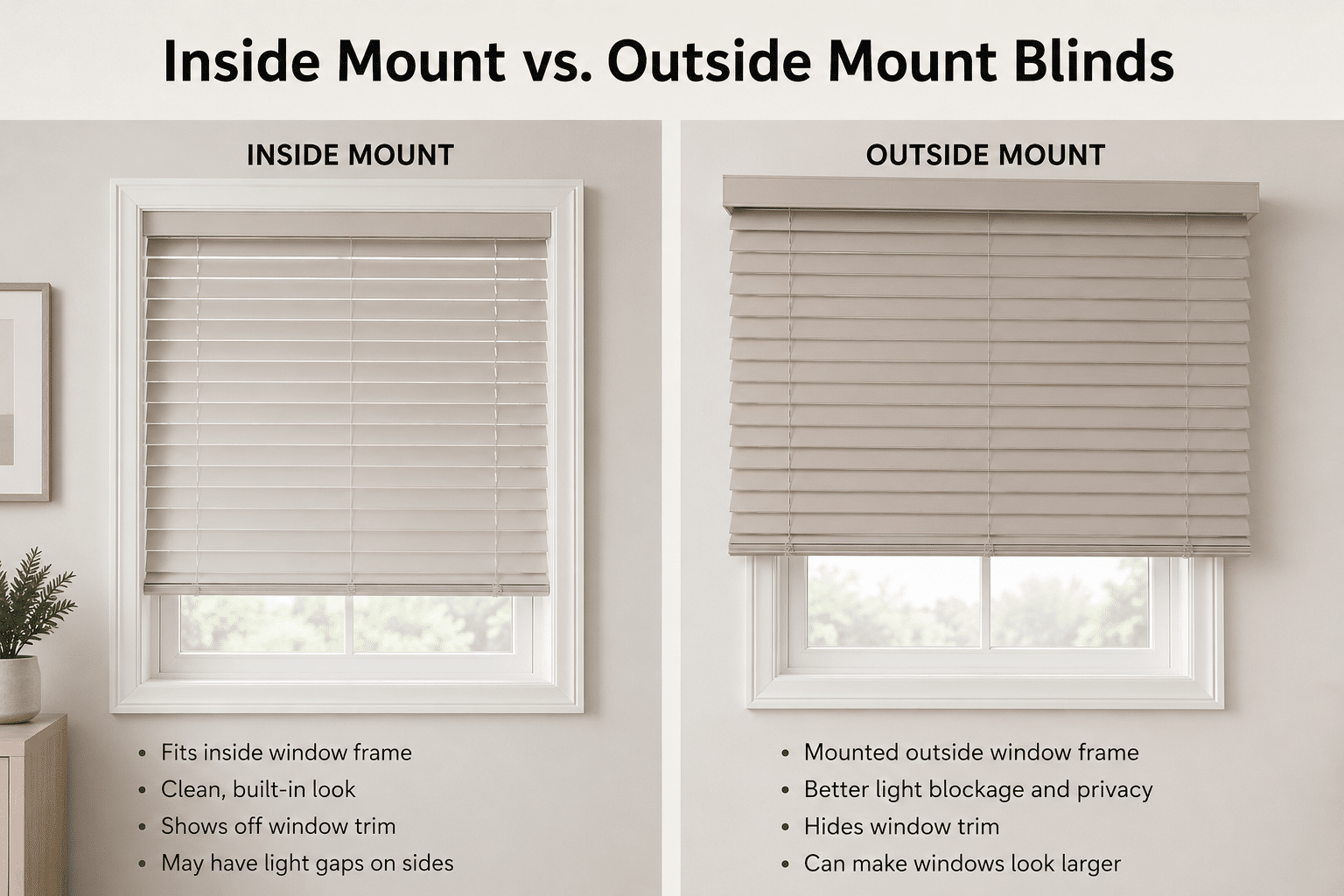
Both mounting styles can work well, but the right choice depends on the window and your goals.
| Feature | Inside Mount | Outside Mount |
| Installation position | Inside the window frame | On the wall or trim |
| Appearance | Clean and built-in | Covers more of the opening |
| Window depth required | Yes | Usually no |
| Window trim remains visible | Yes | May be covered |
| Side light gaps | More common | Usually smaller |
| Suitable for uneven openings | Not always | Often better |
| Suitable for shallow frames | Sometimes | Yes |
An inside mount is usually best when the window is deep enough, mostly square, and free from large obstructions. It is also a good choice when you want to keep attractive trim visible or layer blinds with curtains.
An outside mount may work better when the window is shallow, uneven, or blocked by hardware. It can also provide better light coverage because the blind extends beyond the window opening.
Measuring Tips for Popular Blind Types
Although the general measuring process is similar, some products need additional attention.
Roller and Solar Shades
Roller and solar shade fabric is often slightly narrower than the complete headrail or bracket-to-bracket width. This allows the shade to move freely but can create small side light gaps.
Check the depth required for the brackets, cassette, or fascia. Also make sure window handles and locks will not touch the fabric as it moves.
If maximum room darkening is your priority, an outside mount may provide better coverage than an inside-mounted roller shade.
Zebra Shades
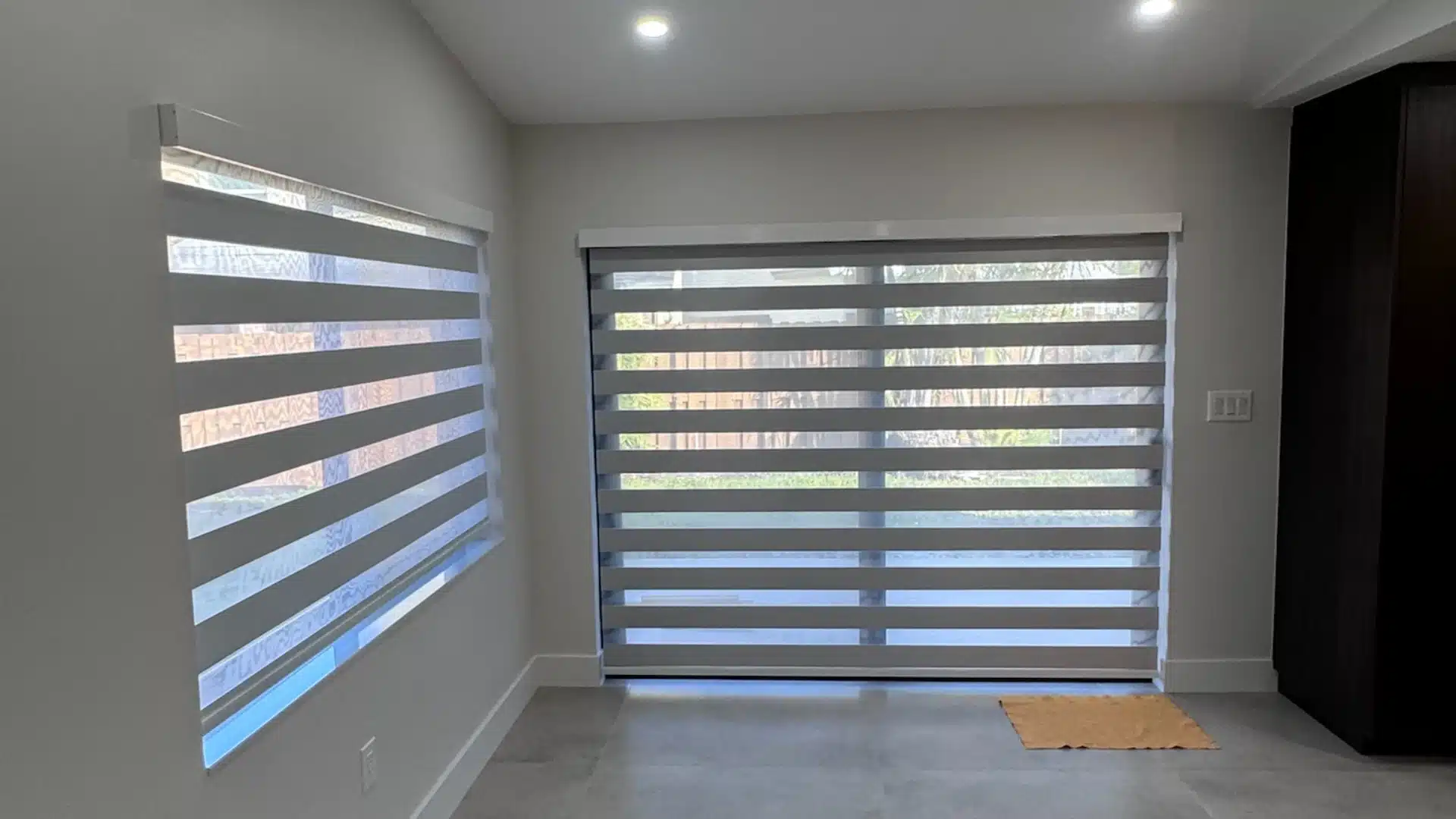
Zebra shades use alternating solid and sheer fabric bands to control light and privacy. They often include a cassette at the top, which may require more window depth than a basic roller shade.
Measure the usable depth carefully and check whether the cassette can sit fully within the opening. You should also expect a small amount of light to enter around the sides of most inside-mounted zebra shades.
If the shade is motorized, confirm that there is enough space for the motor housing and charging access.
Wood and Faux Wood Blinds
Wood and faux wood blinds often have thicker slats, larger headrails, and decorative valances. These features can require more depth than compact fabric shades.
Check the depth of the headrail and valance before ordering. Make sure there is enough clearance for the slats to tilt without touching the glass, handles, or window locks.
Faux wood blinds are often a practical choice for humid areas such as kitchens and bathrooms because they generally handle moisture better than natural wood.
Motorized Blinds
Motorized blinds may need additional space for the motor, battery wand, charging port, power cable, or larger cassette.
The blind may technically fit within the frame while still leaving the charging connection difficult to reach. Consider how the product will be powered and maintained before placing the order.
Professional measurement is often worthwhile for large or expensive motorized blinds because a small error can lead to a costly remake.
Can You Measure the Windows Yourself?
Most homeowners can measure simple rectangular windows by carefully following the correct steps. A steel tape measure and accurate notes are often enough for standard blinds.
Professional measuring may be a better choice for motorized blinds, floor-to-ceiling windows, bay or corner windows, impact windows, arched openings, large sliding glass doors, and extra-wide treatments.
A professional can check more than the width and height. They can also inspect the mounting surface, usable depth, window hardware, bracket position, and product clearance before the blinds are made.
For a single standard window, DIY measuring may be practical. For an entire home or a complex custom project, professional measurement can reduce the risk of expensive ordering mistakes.
Conclusion
Measuring your windows for inside mount blinds doesn’t have to be complicated. By taking accurate width, height, and depth measurements and checking for handles, locks, or other obstructions, you can order blinds that fit properly and operate smoothly. Spending a few extra minutes measuring carefully can help you avoid costly mistakes and ensure your new window treatments look clean and professional.
If you’re ever unsure about your measurements, don’t guess. Different blind styles have different mounting requirements, and even a small error can affect the final fit. Taking the time to double-check your measurements—or getting professional assistance—can save time, money, and frustration.
Whether you’re installing roller shades, zebra shades, faux wood blinds, solar shades, or motorized window treatments, accurate measurements are the first step toward achieving a perfect fit and a polished finish for your home.
Frequently Asked Questions
Which width should I use for inside mount blinds?
For most inside mount blinds, use the smallest of the top, middle, and bottom width measurements. The smallest number represents the narrowest part of the opening. Always confirm the rule in the instructions for your selected product.
Do I measure the glass or the window opening?
Measure the complete inside window opening, not just the visible glass. The blind will be installed between the inside edges of the frame.
Should I subtract from my width measurement?
Do not subtract anything unless the manufacturer or installer instructs you to do so. Many custom blind manufacturers make the required factory deduction after receiving the exact opening size.
Which height measurement should I use?
The correct height depends on the product. Many horizontal blinds and cellular shades use the longest measurement, while some roller shades and vertical blinds may use the shortest. Record all three heights and follow the product-specific instructions.
How deep does a window need to be for inside mount blinds?
There is no single depth requirement for every blind. Check the minimum mounting depth and flush-mount depth listed for the exact product you want to order.
Can inside mount blinds work in a shallow window?
Sometimes. A partial inside mount may allow the brackets to sit inside the frame while the headrail projects forward. A lower-profile blind may also fit. Otherwise, consider an outside mount.
Why do inside mount blinds have side gaps?
Small side gaps allow the blind or shade to move without rubbing against the frame. Roller, solar, and zebra shade fabrics may be narrower than the complete headrail width, creating slightly larger gaps.